
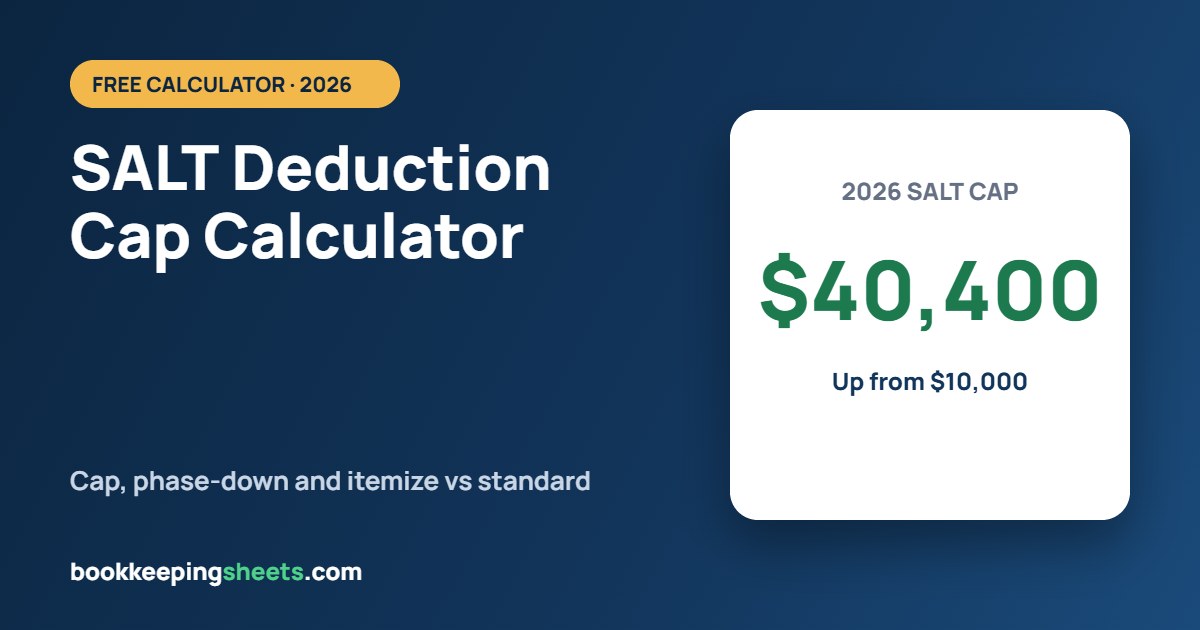
The cap on the state and local tax (SALT) deduction went from $10,000 to $40,000 for 2025 and $40,400 for 2026. That sounds simple, but two things trip people up: the cap shrinks once your income passes about half a million dollars, and the bigger cap only helps if your itemized deductions beat the standard deduction. This calculator handles both and shows what the new cap is worth to you compared with the old $10,000 limit.
SALT deduction calculator
Enter your modified adjusted gross income (for most people, the AGI on Form 1040), the state and local income tax you paid (or general sales tax, if you choose that instead) and your property taxes. Add your mortgage interest and charitable gifts so the calculator can compare itemizing with the standard deduction.
Use the buttons under the result to print or save it as a PDF, download it for Excel, Word or CSV, or share it by link, email or WhatsApp. Your numbers stay in your browser.
The 2026 SALT rules in plain English
- Cap: $40,400 for 2026 ($20,200 if married filing separately). It rises 1% a year through 2029.
- Phase-down: if your MAGI is over $505,000 ($252,500 married filing separately), the cap drops by 30 cents for every dollar above that line.
- Floor: the cap never goes below $10,000 ($5,000 married filing separately), so high earners are back where they were before.
- End date: under current law the cap returns to $10,000 starting in 2030.
| Tax year | SALT cap | Phase-down starts at MAGI |
|---|---|---|
| 2025 | $40,000 | $500,000 |
| 2026 | $40,400 | $505,000 |
| 2027 | $40,804 | $510,050 |
| 2028 | $41,212 | $515,151 |
| 2029 | $41,624 | $520,302 |
| 2030 and later | $10,000 | no phase-down |
What counts as SALT
SALT is the total of two buckets. The first is state and local income tax (what was withheld from your paychecks plus any estimated or balance-due payments made during the year), or, if you prefer, general sales tax instead. You can’t deduct both, so people in states with no income tax usually pick sales tax. The second bucket is property taxes: real estate tax on your home and personal property tax on things like a car, as long as it’s based on the car’s value.
Things that don’t count: federal income tax, Social Security and Medicare tax, gas taxes, HOA fees, transfer taxes on a home you sold, and water or trash fees on your property tax bill.
Who actually benefits from the higher cap
The bigger cap only matters if you itemize. For 2026 the standard deduction is $16,100 single, $24,150 head of household and $32,200 married filing jointly. A married couple paying $9,000 of state tax and $6,000 of property tax with no mortgage would have $15,000 of itemized deductions, far below $32,200, so the new cap changes nothing for them. The people who gain are homeowners in higher-tax states who pay more than $10,000 of SALT and also have mortgage interest or charitable gifts.
Worked example
A married couple has MAGI of $260,000. They paid $14,800 of state income tax, $9,600 of property tax and $16,500 of mortgage interest, and gave $3,000 to charity. Their income is below $505,000, so the full $40,400 cap applies and all $24,400 of SALT is deductible. Itemized deductions come to $43,900, which beats the $32,200 standard deduction by $11,700. Under the old $10,000 cap they would have had only $29,500 of itemized deductions and taken the standard deduction instead. In the 24% bracket the new cap is worth about $2,808 to them for 2026.
The phase-down zone
Between $505,000 and about $606,333 of MAGI the cap falls from $40,400 to the $10,000 floor. In that range every extra dollar of income costs you 30 cents of SALT deduction, which works like a hidden tax rate increase. If you’re close to the line, it can be worth looking at ways to lower MAGI, such as bigger 401(k) contributions, and talking it through with a tax professional before year-end.
A note for business owners
Many states let partnerships and S corporations pay state tax at the entity level (a pass-through entity tax, or PTET). That tax is deducted by the business, not on your personal Schedule A, so it isn’t limited by the SALT cap. If you own a small business in a high-tax state, ask your tax preparer whether your state offers it. To plan your federal payments for the year, use the quarterly estimated tax calculator.
Related calculators and templates
- Quarterly Estimated Tax Calculator
- Paycheck Calculator 2026
- No Tax on Tips & Overtime Calculator
- Self-Employment Tax Calculator 2026
FAQ
Is the SALT cap $40,000 or $40,400 for 2026?
$40,000 was the 2025 figure. For 2026 the cap is $40,400, and the income where the phase-down begins rises to $505,000.
Do I need to itemize to get the SALT deduction?
Yes. SALT is an itemized deduction on Schedule A, so it only helps if your total itemized deductions are more than your standard deduction.
Can I deduct both state income tax and sales tax?
No. You choose one of the two, plus property taxes. The IRS sales tax tables or calculator can estimate the sales tax figure.
Does the cap apply per person or per return?
Per return. A married couple filing jointly gets one $40,400 cap; filing separately gives each spouse $20,200.
What happens in 2030?
Under current law the cap goes back to $10,000 ($5,000 married filing separately) for 2030 and later years.
Sources
- IRS Topic 503: Deductible taxes
- IRS: Working Families Tax Cuts (2025 tax law) provisions
- IRS: About Schedule A (Form 1040)
This calculator gives an estimate for general information. It isn’t tax, legal or financial advice. For your own situation, talk to a tax professional.
Leave a Reply